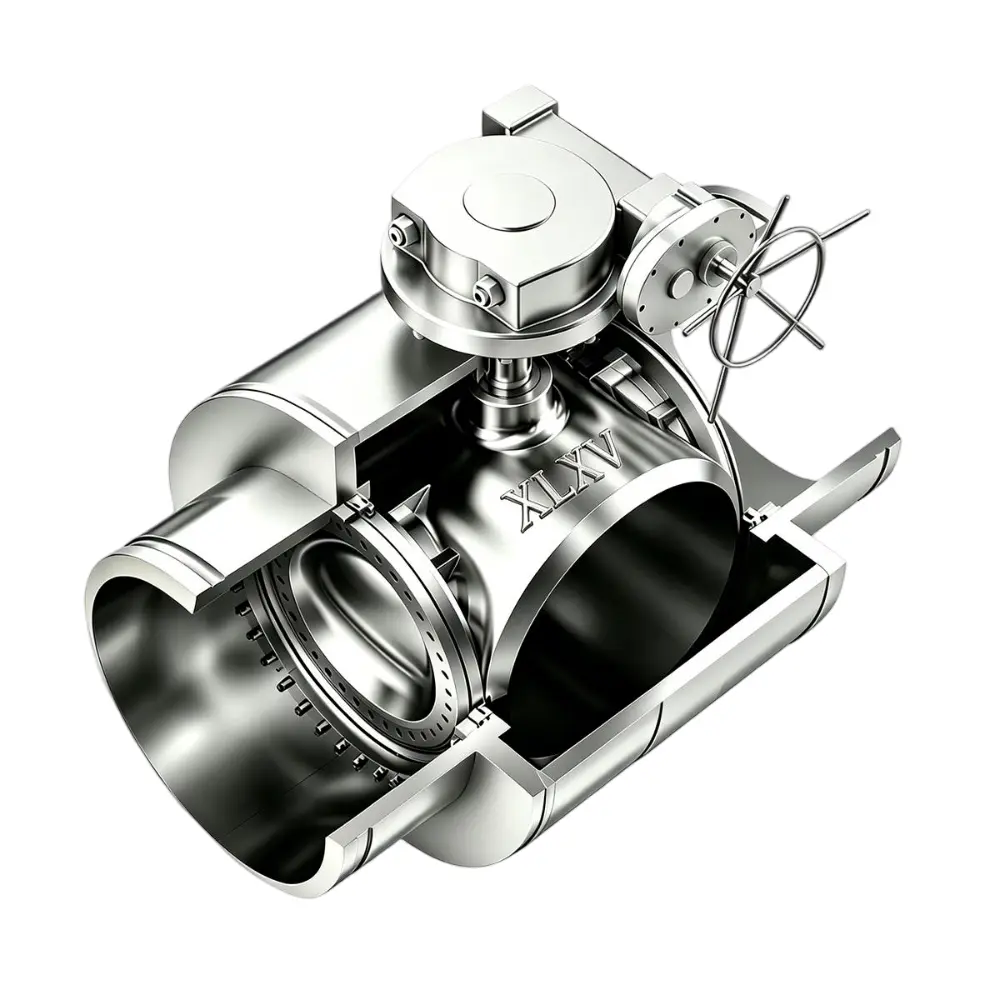
The Five‑Offset Fully‑Welded Heating‑Supply Ball Valve is a high‑performance pipeline ball valve specially designed for urban district heating, thermal pipe networks and high‑temperature hot‑water transportation systems. Adopting a five‑offset structure and a fully‑welded valve‑body design, the valve enables the ball to follow a special eccentric motion path of “separation‑rotation‑engagement” during opening‑closing cycles, which effectively reduces friction and wear on the sealing surfaces.
The fully‑welded body is connected by welded ends, eliminating external leakage points caused by conventional flanged connections. It delivers excellent integral strength and sealing reliability, and is particularly suitable for buried installation and long‑term continuous‑operation heating‑supply pipe networks.
Working Principle of Five‑Offset Fully Welded Ball Valve:
Opening Process: A handwheel, worm‑gear or actuator drives the valve stem to rotate. With the five‑offset geometric structure, the ball separates from the valve seat instantly as rotation starts, and the sealing surfaces are completely disengaged with no‑contact friction throughout the rotating stroke. The flow passage of the ball opens gradually for smooth medium flow, and the valve reaches its fully‑open position after a 90° rotation.
Closing Process: The ball is driven to rotate in the reverse direction, and the flow passage is gradually closed. Once the ball is rotated into position, the five‑offset structure generates wedging force to axially press the ball against the valve seat, forming a high‑load bidirectional seal to cut off medium flow. The sealing surfaces remain friction‑free during the whole opening‑closing rotation, with contact occurring only momentarily during final compression and pre‑opening separation.
Manual ball valves are widely used on piping systems for fast opening and closing, to cut off or connect fluid media stably. Accurate parameter confirmation including working temperature, medium, pressure and caliber is required before ordering for correct valve selection. Customized solutions on valve size, pressure rating, connection standard and body material are available to meet diverse non-standard working conditions.(Unit: mm)

| DN | NPS | Type/Class | Part No | L | d | DH | H2 | H1 | w | |
|---|---|---|---|---|---|---|---|---|---|---|
| 150 | 6 | Q661-PN16-40 | Q6611640XLX6 | 350 | 168 | 219 | 200 | 151 | 140 | |
| 200 | 8 | Q661-PN16-40 | Q6611640XLX8 | 400 | 219 | 273 | 246 | 193 | 200 | |
| 250 | 10 | Q661-PN16-40 | Q6611640XLX10 | 533 | 273 | 351 | 285 | 238 | 400 | |
| 300 | 12 | Q661-PN16-40 | Q6611640XLX12 | 635 | 325 | 426 | 323 | 278 | 400 | |
| 350 | 14 | Q661-PN16-40 | Q6611640XLX14 | 680 | 377 | 508 | 365 | 315 | 500 | |
| 400 | 16 | Q661-PN16-40 | Q6611640XLX16 | 762 | 426 | 580 | 410 | 370 | 500 | |
| 450 | 18 | Q661-PN16-40 | Q6611640XLX18 | 850 | 480 | 675 | 457 | 425 | 600 | |
| 500 | 20 | Q661-PN16-40 | Q6611640XLX20 | 914 | 530 | 740 | 495 | 465 | 600 | |
| 600 | 24 | Q661-PN16-40 | Q6611640XLX24 | 1067 | 630 | 805 | 545 | 520 | 400 | |
| 700 | 28 | Q661-PN16-40 | Q6611640XLX28 | 1245 | 730 | 965 | 625 | 615 | 400 | |
| 800 | 32 | Q661-PN16-40 | Q6611640XLX32 | 1372 | 830 | 1120 | 702 | 663 | 600 | |
| 900 | 36 | Q661-PN16-40 | Q6611640XLX36 | 1524 | 940 | 1280 | 790 | 755 | 500 | |
| 1000 | 40 | Q661-PN16-40 | Q6611640XLX40 | 1727 | 1045 | 1410 | 865 | 825 | 500 | |
| 1200 | 48 | Q661-PN16-40 | Q6611640XLX48 | 1900 | 1250 | 1570 | 965 | 920 | 600 | |
| 1400 | 56 | Q661-PN16-40 | Q6611640XLX56 | 2100 | 1450 | 1890 | 1105 | 2 | 600 | |
| 1600 | 64 | Q661-PN16-40 | Q6611640XLX64 | 2430 | 1630 | 2220 | 1280 | 1235 | 600 |
The five‑offset zero‑friction sealing structure prevents scuffing during opening and closing, greatly extending the service life of the valve seat. The integral fully‑welded body eliminates external leakage points to provide safe and reliable sealing and reduce leakage of thermal‑service media. The monolithic welded construction resists foundation settlement, seismic load and thermal‑cycle fatigue, making it ideal for buried installation.
Boasting excellent high‑temperature resistance, the valve is suitable for thermal working conditions such as hot water and steam. It provides bidirectional sealing capable of withstanding differential pressure from both pipeline directions. The straight‑through flow passage delivers low‑flow resistance and cuts energy consumption for heat transportation. With maintenance‑free design, it requires minimal inspection work in later service. Multiple actuation options are available, including handwheel, worm‑gear, electric and pneumatic operators. It serves as the preferred valve for long‑distance transmission on trunk pipelines of urban district‑heating networks.